
Technoprogressive Makerspaces: Rebuilding Local Communities
by William Sims Bainbridge
Technoprogressive Policy Project
William Sims Bainbridge recently completed 31 years as a program director at the National Science Foundation, first in Sociology then in Human-Centered Computing. He has published extensively on technological social movements, religious intentional communities, and computer science innovations.
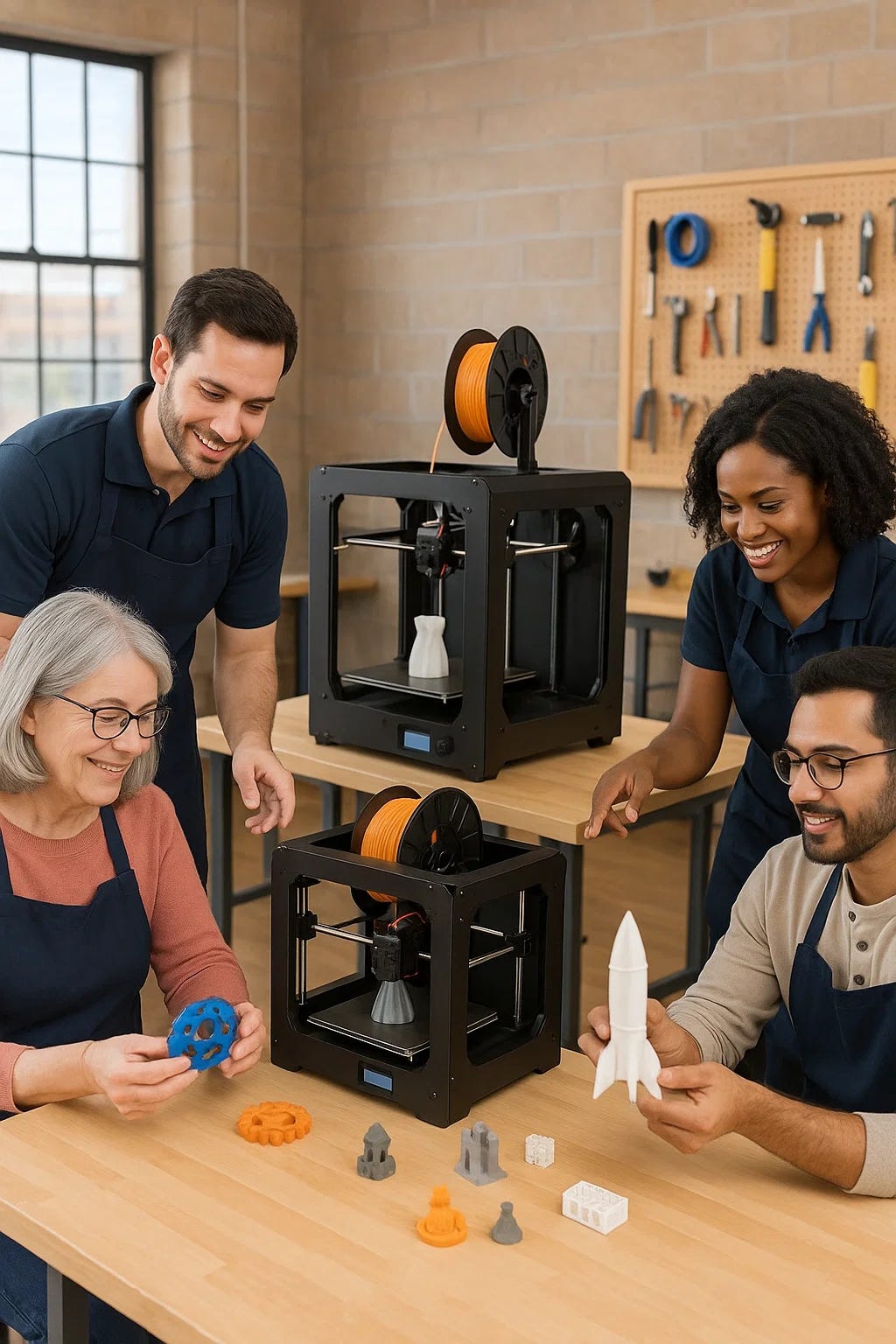
While efficient mass production factories were the natural result of the Industrial Revolution, the smart information technologies of our post-industrial age make possible the transition of much fabrication to small local workshops that could support social equality, even perhaps structured as communes.
On June 17, 2014, president Barack Obama proclaimed that the following day would be a National Day of Making. “Today, more and more Americans are gaining access to 21st century tools, from 3D printers and scanners to design software and laser cutters. Thanks to the democratization of technology, it is easier than ever for inventors to create just about anything.” The National Science Foundation supported fundamental research to develop the technologies for what was called the Maker Movement, which NSF tended to conceptualize as an educational tool rather than exploration of a beneficial new support for community. Subsequent administrations failed to follow this creative course.
Over the following decade, however, artificial intelligence and related information technologies have advanced, preparing for a new effort to develop tools, evaluate application areas, and consider new norms to maximize the quality and reliability of small-scale making. This will require collaboration across multiple fields of discovery, from chemistry and engineering to sociology and anthropology. Many departments of colleges and universities should engage in fundamental research and also set up prototype experiments on how makerspaces can best be established as enduring and beneficial organizations.
Citizens can be equal without being identical. If many people want to work in makerspaces and live in connected communes, that does not mean that everyone needs to. Indeed, one benefit of the new technologies for rapid adjustment of the design of products is that individuals can purchase those that most exactly meet their own preferences. Given that furniture and many other household items last for decades, the low cost of mass production is less of an advantage, because local makers can be faithful to the styles and values of the surrounding community. AI can take input, for example from photographs, and quickly operate production tools to make personalized goods, such as a sculpture of a deceased family member, a toy dollhouse that matches the house a child inhabits, or duplicates of works of art from any tradition which the customer adores.
Many public policies will need to be developed, perhaps with complex features that differ across particular categories of products and the characteristics of the surrounding community. For example, it might be appropriate in some cases for large corporations to provide machinery and raw materials for franchises of largely independent makerspaces. Or this might contradict the goal of achieving substantial social equality, and agencies of government might need to take over those large-scale roles.
Much of the economy now involves providing services, rather than producing products, so many research studies will need to be done to learn how widely these principles can be extended. For example, we might imagine that each town in the future will have one cooperative dental office, including production of replacement teeth rather than ordering them from a distant factory. Given how information technology already assists the dental profession, perhaps we will gain better services at lower cost. New service professions seem already to be emerging, for example provision of personal or business websites and replacing traditional local libraries with online archives. By analogy with makerspaces, we might coin the term “serverspaces,” while acknowledging that many cases lie between these categories, as is the case for dentists.
To the extent that makerspaces and serverspaces represent strong social groups that value equality, even communes, their members will also effectively provide volunteer help to each other, often in less formalized ways but requiring encouragement and guidance from public policies. At the opposite end of the good versus evil spectrum, we will need to be alert to the modes of harm that may be done by large corporations or even criminals.
An important early stage of research to prepare for this future is the study of existing examples, with awareness of the extensive scholarship already completed on historical cases such as Amana, Oneida and the Shakers. However, the past can offer only suggestions, not perfect advice on how to thrive in the future.
I must admit that my personal inspiration for this idea was visiting the Twin Oaks Community in Virginia, way back in August 1968, and purchasing one of its marvelous rope hammocks. I had been invited by Kathleen Kinkade, one of its founders, who later published a history of its early years, A Walden Two Experiment. Originally, Twin Oaks had been inspired by the Walden Two utopian novel written by behavioral psychologist, B. F. Skinner, who was himself inspired by Walden, written by Henry David Thoreau, which urged living closer to nature.
It is important to note that American communes were only seldom based on anything like Marxism, so Americans must learn to be far more tolerant of intentional communities, respecting them as social experiments based on a great diversity of creative concepts. I myself recently meditated about Walden Three: “From the intersection of computational science and technological speculation, with boundaries limited only by our ability to imagine what could be. Can humanity take its next step forward by taking a step back?” Or perhaps returning to cohesive local communities is the natural result of post-industrial technological progress.