
How Do Technoprogressives Understand Social Change?
Reflecting on the rise of fascism and the Epstein class through the lens of post-Marxist and technoprogressive social theory


In graduate school, I had an epiphany in a class about social theory. One broad set of theories, “functionalism,” argued that social practices could be explained by the functions necessary for society to reproduce itself. The welfare state fills gaps in social needs, allowing workers to stay healthy and children to get educated. The other broad set of theories explained things in terms of power and exploitation: “conflict theories” such as Marxism, feminism, and anti-racism. For conflict theory, the welfare state is achieved through social struggle, while it also serves to suppress more militant demands for change, and its policies reflect patriarchy and racism.
The epiphany was the realization that this was a false dichotomy. There are separate systems that are necessary for social reproduction, and each social system has its own characteristic forms of power. Like a body with multiple systems, each can tip from healthy functioning to pathology. Military power or religious authority is used to accumulate wealth and dominate the media. Excess inequality and exploitation are like cancers in each system. The democratization of society requires understanding the dynamics and functions of these systems, and then determining how far we can democratize power within each system. How do we maximize equality and freedom in every domain, and still get all the necessary stuff we all want done?
One Ring Doesn’t Rule Them All
Around the same time, I read Liberating Theory, a short 1986 book written by a committee for a specific political project: proposing a way of seeing race, class, gender, and the state as separate but interlocked social systems. Each domain had forms of power specific to it, and its subalterns’ political demands were “relatively autonomous.” The New Left authors were arguing against the various hegemonic leftisms on offer, from Marxist class reductionism to bioessentialist feminism, racial nationalism, and anarchism.
The 19th-century Marxist-anarchist debate was a prelude to the Liberating Theory argument. Was state power – politicians backed by soldiers – as important a source of oppression as wealth? Bakunin said, “If there is a state, then there is unavoidably domination.” The Soviet experience handed the win to the anarchists. However, most radicals still conclude that we need government, laws, and law enforcement – governance is an essential function, even if we rename it “people’s committees.” The goal is as democratic, transparent, and accountable a government as possible, i.e., liberal democracy. The struggle for civil liberties and liberal democracy against authoritarianism is a precondition for economic and social democracy. The social democratic project over the last century has been to extend a rich conception of democracy to all spheres.
The socialist-feminist debates of the 1970s were the immediate prelude to Liberating Theory’s four-way debate. Patriarchy predates class, property, or labor-based exploitation by thousands to millions of years. The Marxists had tried for 150 years to understand the dynamics of sex, gender, and reproduction through the lens of labor, with only partial success. If you study the circulatory system, you will find it deeply embedded in the nervous and immune systems. Diseases that originate in one system affect the others, but they are still best understood as separate. All the systems are necessary, and there is no reason to ignore the peculiar dynamics in one and pretend they can be explained best as a derivative of the mechanics of another.
The key observation of socialist-feminism was that women and sexual minorities are not automatically liberated by socialism or a planned economy. However, the state control of the economy certainly can accelerate women’s incorporation in occupations, and the welfare state can facilitate their freedom from sex/gender constraints. Feminist and LGBT rights, with their own distinct material interests, require separate politics from the workers’ movement.

The authors of Liberating Theory called their approach “complementary holism,” but it never took off in sociology or as a political project. Instead, the Left adopted the language of “intersectionality,” which often amounted to a simple affirmation that all forms of power are interwoven and mutually reinforcing. While this is often the case, there are also circumstances and dynamics in which one system or system of power can interfere with others. When capitalist industrialization moved most of the population from farms to factories, it radically disrupted extended families. When capitalists finally supported the abolition of slavery or offered women independence through wage labor, they undermined white supremacy and patriarchy. Capitalists usually see it as more profitable to accede to racist or patriarchal practices… until it’s not; profit-maximizing comes before conservation of heteronormativity or white supremacy. Bad Bunny was still at the Super Bowl, even in this fascist moment.
Intersectionality discourse stripped away much of the complexity of a sociological multi-systems perspective. It also under-theorized the dynamics of social change, in particular the role of technology. Marxism proposed that technological innovation would change the structure of society, concentrating wealth and power, and uniting an immiserated transnational working class around the expropriation of the transnational owning class. Technology driven by a particular political economy - capitalist industrialization - creates the parties - workers v owners - and conflicts – class struggle - that drive change. Surely technological innovations are also catalytic in changing the power relations in other parts of society?
Are Technoprogressives Technological Determinists?
The role of technology in driving social change is another broad axis in social theory. Technological theory ranges from techno-determinists who believe that all important social change is driven by technological innovation and that technological progress has its own inescapable logic, to those who see big ideas or cultural forces as the determinants of change and technological innovation as something that can be steered or reversed. The Marxian tradition is largely in the technological-determinist camp, although empirically, Marxists acknowledge that every example has cultural and political specificity and is open to historical counterfactuals. A more sophisticated approach, suggested by Stephen J. Gould’s punctuated equilibrium model of natural selection, is to view technological innovation as an abrupt perturbation of the ecological terrain that stochastically enables rapid political and economic change. Technology opens the possibility, and our struggles determine the outcome.
This is the lesson of Graeber and Wengrow’s analysis of prehistoric civilization in The Dawn of Everything: A New History of Humanity. At every level of technology humans had a wide array of choices about how equal or oppressive they could be. Just because slavery and feudalism were common does not mean slavery was inevitable for that level of technology. Technological innovation changes the terrain of struggle and redistributes the weapons, but it doesn’t fix the game. Technologies have clearly allowed us to ratchet societies in freer and more egalitarian directions, even if progress is not guaranteed.
This is a central idea in a technoprogressive social theory: in general, technological innovation expands human freedom by freeing us from the burdens of social reproduction, and giving us a better deal at work, in the family, as citizens, and in the culture. Advances in the means of production are freeing us from drudgery, although we still have to struggle against the wealth inequalities it produces because of property relations. Industrialization and knowledge work gave women economic independence, and encouraged women’s education, while birth control and abortion gave women more choices over childbearing. Technology opened radical new freedoms from oppressive sex/gender norms and patriarchal power. This is why transgender therapies, the use of technologies to push back the oppressiveness of biology, have become the bête noire of the “anti-gender” patriarchal restorationists.
Plural Systems and Coalitional Politics
This stochastic view of technology’s role in social change is implicitly technoprogressive, a synthesis of the determinist and idealist approaches. However the argument for why a neo-functionalist, post-Marxist, multi-systems view is technoprogressive is more tenuous. There are certainly technoprogressives without a theory of social power or social change, and some who believe there is one dominant form of social power. I’ll just footnote that social change theories that adopt biological, evolutionary or cybernetic heuristics, heuristics that incorporate multi-systemic dynamics, are more illuminating than, for instance, Hegelian dialectics, which has at most one hegemonic system and its reaction.
The relevance of the “dual system” and then multi-system debates to the practical politics of the 1980s seemed obvious amidst post-New Left coalition efforts like Jesse Jackson’s Rainbow Coalition. If progressive politics was no longer just rich versus power, but a collection of a dozen justice movements, how do we even explain what we have in common? The answer in my social democratic political organization, the Democratic Socialists of America, was “democracy”: we want to democratize every corner of society. The voice of the organized working class may need more amplification than other voices, but they are all part of the choir. A multi-systems view of power implied not only that no one form of power could be reduced to being derivative of another, but that no one organization could represent all the forms of liberal and egalitarian struggle within each domain. Social democratic parties could represent these diverse movements with a common moral language and vision, but not by setting one movement above the others. The result of this “identity politics” turn however was the fragmenting of a unifying identity, and the sacrifice of economic populism – fighting the 1% - for the expansion of liberal rights.
Looking back on the last forty years, the changes to the sex/gender system came astonishingly fast. Women’s empowerment and sex/gender freedom proceeded quickly in the developing and developed world alike, driving down marriage and fertility. Meanwhile, labor unions rooted in industry were being decimated by trade and technological innovation, and social democratic parties were finding a new base in the educated middle class, within which educated women were a powerful constituency. Poor and blue-collar men bled to the far right as they displaced their anxieties about economic precarity onto immigrants, and their anxieties about eroding patriarchy onto misogyny and transphobia. As the far right, fascist, and illiberal forces grew around the world, they have almost universally promised to roll back “gender” while adopting a wide variety of economic policies, libertarian to statist, albeit always preserving the wealth of kleptocratic elites.
The centrality of patriarchal restoration to the fascist project, and the growing gender gap in political ideology and partisan preferences, is empirical evidence that “class de-alignment” reflects the multipolar nature of social power and the coalitional nature of the progressive project. Class dealignment is not just the replacement of real material interests with fake culture war division. It is also the recognition of different material interests, with equal legitimacy as progressive political projects. Just as workers have common interests across national borders, so do people who want to be free from sex/gender oppression.
The Epstein Power Elite
Which brings me to the Epstein files. The kinds of violence against women and girls enacted by the Epstein conspirators happens at every level of social class. What is uniquely visible in the Epstein files is the impunity that the oligarch elites enjoy for their misogyny and trafficking. The US center Left realized the tragic consequences of having tribally defending Bill Clinton in the 1990s, despite evidence of his character. Yet, the tribal nature of the Epstein conspiracy again led many American progressives to ignore the scandal. Now it has become the largest data dump of elite influence peddling, backroom diplomacy, and financial backscratching ever made available for social science and citizen sleuthing, all tied together by horrific crimes against women and girls.
The global rise of fascism is a demonstration of the multipolar nature of power and the need for a coalition of relatively autonomous organizations fighting for sex/gender freedom alongside workers’ rights, the rights for cultural minorities, and civil liberties. The Epstein saga is a case study of how important patriarchal violence and power are for the global ruling class. The Epstein class isn’t just a financial cabal, but a biopolitical one that uses patriarchal violence (trafficking) as a glue for elite cohesion.

The Epstein case also illustrates what C. Wright Mills called The Power Elite, which is another multipolar theory of power. Mills argued against Marxist reductionism, focusing solely on the owners of capital. Like the functionalists and complementary holists, C. Wright Mills assumed that there are multiple castles of social power: politics, the military, entertainment, religion, and the academy, in addition to business and wealth, each with its own elite. Elites in different castles mix it up through social activities, performing the informal work of elite coordination at country clubs and private islands. For the Epstein class, his island was one such “room where it happens.” His email archive shows the web of alliances connecting the Kremlin, Mossad, Saudi, British, and European royals, the tech oligarchs, and the MAGA fascist White House. Unfortunately, C. Wright Mills was blind to the pervasive patriarchy in all those castles and their country clubs. The Epstein files brings that patriarchy to center stage.
A related technoprogressive point about the Epstein files is that, compared to previous scandals, they reveal the profound difference information and communication technologies make for the transparency and accountability of elites. This case dumped millions of records into the hands of eight billion forensic detectives. While Palantir is building the database for repression, we are also liberating data for bottom-up accountability. It may take years for democratic forces in the United States to hold our criminals accountable, but elites around the world are already being held to account.
A Multi-system View of Technopolitics
So the technoprogressive question is how technological innovation opens more liberal and egalitarian ways to accomplish the core needs of social reproduction. If AI erodes work, and we adopt a universal basic income, we are expanding human freedom at the expense of capitalist wage slavery. We have to be clear about whether there are trade-offs between equality and efficiency; progressives have to demonstrate that they can make the trains run on time even if they are free. We still want sustainable economic growth, and for economic dislocation from automation and UBI to occur at a managed pace. Technoprogressives are not, for the most part, accelerationists who want innovation to cause a collapse of the economy and state.
Technoprogressives, like the New Left theorists before, also need to decide how much attention to give to technopolitical issues “outside” of the economic, such as sex/gender liberation, anti-racism and anti-authoritarianism. If, as Shulamith Firestone proposed, we extend access to reproductive technology to artificial wombs, then we can more easily reproduce without forcing disproportionate burdens on women. Artificial wombs could enable greater sex/gender freedom, just as contraception and abortion have. The patriarchs and sex/gender traditionalists will try to commandeer artificial wombs for repression, using them as an argument for forced “fetal rescue” from women wanting to end pregnancies. Whether artificial wombs are liberatory depends on the outcome of social struggle.
In the current debate over rebuilding blue-collar, male, and centrist support for progressive policies, transgender rights are often framed as the step too far for ordinary people. This misunderstands the centrality of the trans cause to sex/gender freedom. As we continue to perfect our technological control of secondary sex characteristics, we chip away at the remaining constraints of the two-billion-year-old sex bifurcation accident, toward full postgender morphological freedom.
The relative autonomy of social systems and their different forms of power underlie the need for a coalitional progressivism that unites disparate causes through shared values, rather than a single hegemonic ideology and organization. The technoprogressive project is also coalitional. In the Technoprogressive Declaration, we framed the project as reaching out to a coalition encompassing all projects of Enlightenment social reform, while pointing them toward the liberatory potentials of emerging technologies.
Partisans of the promises of the Enlightenment, we have many cousins in other movements for freedom and social justice. We must build solidarity with these movements, even as we intervene to point to the radical possibilities of technologies that they often ignore.
The technoprogressive political tendency has no necessary social theory. But a multi-system view of power informs the technoprogressive project better than reductionist views. We must recognize that the struggle against the “Epstein class” is not merely a fight against concentrated wealth, but also patriarchal violence, state capture and the global promotion of racist parties, converging to shield an unaccountable elite. The technoprogressive task is suggest how we can use emerging technologies to liberate ourselves from not only natural and social necessity, but unnecessary inequalities. By democratizing the “separate castles” of power and ensuring that innovation serves as a scaffold for bodily and economic autonomy, we find the Good Fight in every battle. In the words of Nemik, “The frontier of the Rebellion is everywhere. And even the smallest act of insurrection pushes our lines forward.” The future is not a predetermined output of our machines, but a stochastic terrain where our small acts of insurrection determine the final outcome.
Events
AI + work: Building pro-worker AI. Wednesday, February 25, 2026, 2:00 - 3:00 p.m. EST. What is pro-worker artificial intelligence (AI), and how can we build it? On February 25, The Hamilton Project at the Brookings Institution will host a virtual event to discuss pro-worker AI.
Online only: https://www.hamiltonproject.org/event/building-pro-worker-ai/
Nir and J host Prosthetic Gods event - Sidore Memorial lecture – April 2, 2026 – Portsmouth, NH We will be taping an episode with a live studio audience, and then participating in debates with students about some of the topics we have discussed. A good time will be had by all.
https://www.themusichall.org/events/sipsofscience2604/
Horizons in Ethics and Emerging Technologies – April 16, 2026 – Turin, Italy
The inaugural conference of the Hub for Ethics and Emerging Technologies (HEET), a new research hub affiliated with the Institute for Ethics and Emerging Technologies (IEET), is based at the University of Turin. This full-day event will bring together leading experts and early-career researchers to explore the ethical dimensions of emerging technologies, including human enhancement, artificial intelligence, and quantum technology.
https://ieet.org/heet-2026/
Technoprogressivism Course – June 15-August 21 - online
This summer Matteo McDermant and I will be teaching a course on technoprogressivism. Email director@ieet.org if you would like be added to the course mailing list.
News Roundup
IEET Technoprogressive Project
Bread and Robots talks to Maren Costa about Amazon Employees For Climate Justice.

Technoprog Transhumanism: A Conversation with Marc Roux.
Are They Alive?
“A Pragmatic View of AI Personhood” by Joel Z. Leibo, et al. – We may never know for sure, but we still have to set and defend ways of determining personhood.
https://arxiv.org/abs/2510.26396
“What is Consciousness? Nested Observer Windows, Meta-Awareness & Mind Wandering” with Jonathan Schooler. Introduces the Nested Observer Windows (NOW) model, which posits consciousness as a mosaic of nested experiential windows where each window has its own “now,” and emphasizes the importance of openness to experience for both individual well-being and humanity’s future.
“Bootstrapping Life-Inspired Machine Intelligence: The Biological Route from Chemistry to Cognition and Creativity” by Giovanni Pezzulo and Michael Levin. We argue that biological evolution has discovered a scalable recipe for intelligence - and the progressive expansion of organisms’ “cognitive light cone”, predictive and control capacities. To explain how this is possible, we distill five design principles - multiscale autonomy, growth through self-assemblage of active components, continuous reconstruction of capabilities, exploitation of physical and embodied constraints, and pervasive signaling enabling self-organization and top-down control from goals - that underpin life’s ability to navigate creatively diverse problem spaces. We discuss how these principles contrast with current AI paradigms and outline pathways for integrating them into future autonomous, embodied, and resilient artificial systems.
https://arxiv.org/abs/2602.08079
“Insects, AI Systems, and the Future of Legal Personhood,” by Jeff Sebo. Our current framework for assessing legal personhood, coupled with our current framework for assessing risk and uncertainty, imply that we should treat these kinds of individuals as legal persons.
https://law.lclark.edu/live/files/37661-sebopdf
“What Is Claude? Anthropic Doesn’t Know, Either” by Gideon Lewis-Kraus. Researchers at the company are trying to understand their A.I. system’s mind—examining its neurons, running it through psychology experiments, and putting it on the therapy couch.
https://www.newyorker.com/magazine/2026/02/16/what-is-claude-anthropic-doesnt-know-either
Can They Kill and/or Defend Us?
“US, China opt out of joint declaration on AI use in military” by Victoria Waldersee. Around a third of countries attending a military AI summit in February in Spain agreed to a declaration on how to govern deployment of the technology in warfare, but China and the U.S. opted out.
https://www.reuters.com/business/aerospace-defense/us-china-opt-out-joint-declaration-ai-use-military-2026-02-05/
“US Army looks for robots that can clean up chemical and bioweapons messes” by Brandon Vigliarolo. Just in time for the predicted rise of AI-assisted threats.
https://www.theregister.com/2026/02/04/army_bots_cleanup_ai_biological_chemical
Must We Sell Our Labor Or Die?
“What if Labor Becomes Unnecessary?” by David Autor, Anton Korinek and Natasha Sarin. In this expert discussion there is no agreement about the immediacy of job losses, but they converge on the urgent need for institutional reforms—such as universal basic capital or enhanced wage insurance—to ensure that the dividends of automation are shared broadly rather than captured by a narrow elite.
https://www.nytimes.com/2026/02/04/opinion/ai-jobs-employment-industry.html
“America Isn’t Ready for What AI Will Do to Jobs” by Josh Tyrangel. Does anyone have a plan for what happens next?
https://www.theatlantic.com/magazine/2026/03/ai-economy-labor-market-transformation/685731/
“Tech CEOs Say AI Is Ushering in an Age of Abundance, But Instead the Evidence Shows That It’s Pushing Down Wages” by Joe Wilkins.
https://futurism.com/future-society/ai-bubble-wages-economy
“It’s Starting to Look Like AI Has Killed the Entire Model of College” by Joe Wilkins. College no longer offers a return on investment.
https://futurism.com/future-society/ai-college-internships-jobs
“The singularity won’t be gentle” by Nate Silver. If AI has even a fraction of the impact that many people in Silicon Valley now expect on the fabric of work and daily life, it’s going to have profound and unpredictable political impacts.

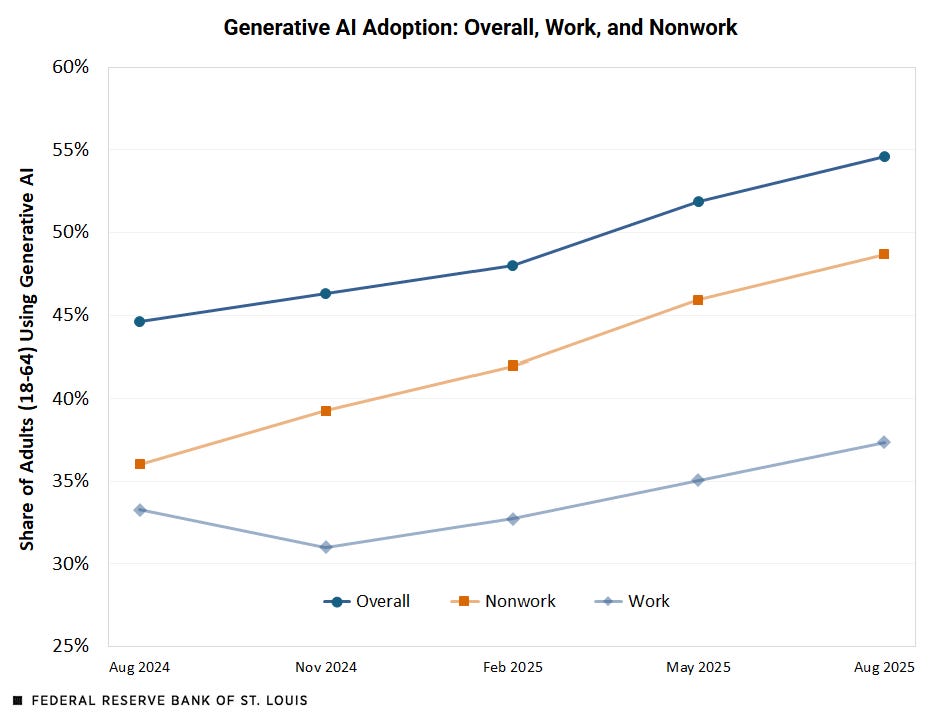
“The State of Generative AI Adoption in 2025” By Alexander Bick , Adam Blandin , David Deming. More than half of Americans are regularly using generative AI, more often for non-work purposes.
https://www.stlouisfed.org/on-the-economy/2025/nov/state-generative-ai-adoption-2025
Can We Control Our Own Bodies and Live Another Day?
“Who We Are: Gender Ideology” by Leor Sapir and Rafael A. Mangual. How gender discourse evolved over the past decade, including cultural and policy shifts during the Obama administration, and how these developments reshaped institutions, media narratives, and social norms.
https://www.city-journal.org/multimedia/who-we-are-gender-ideology
“FDA Targets Gender-Affirming Garments, Warning Companies that Serve Trans Customers” by Hallie Lieberman. At least 12 companies received letters from the agency stating that chest binders, a compression garment, are medical devices and require compliance with strict federal regulations.
https://rewirenewsgroup.com/2026/02/02/chest-binders-fda-letter-gender-affirming-trans-customers/
“Texas man sues California doctor for allegedly sending abortion pills to state” by Marina Dunbar. Suit is the first under new law allowing residents to sue providers protected in their states under ‘shield laws’.
https://www.theguardian.com/us-news/2026/feb/04/texas-california-abortion-pills-lawsuit
“Chinese scientists develop stretchable electrodes for invasive brain-computer interface, breaking key bottleneck” by Feng Fan.
https://www.globaltimes.cn/page/202602/1354982.shtml
“Is India about to make Ozempic-like weight-loss drugs a whole lot cheaper?” by Ayushi Shah.
https://www.cnn.com/2026/02/07/india/india-semaglutide-patent-expiry-intl-hnk-dst
“COVID-19 mRNA Vaccination and 4-Year All-Cause Mortality Among Adults Aged 18 to 59 Years in France” by Laura Semenzato, et al. Vaccinated individuals had a 74% lower risk of death from severe COVID-19 and no increased risk of all-cause mortality over a median follow-up of 45 months.
https://jamanetwork.com/journals/jamanetworkopen/fullarticle/2842305
“The ethics case for longevity science” by Zhuang Zhuang Han and João Pedro de Magalhães. We address three kinds of critiques: philosophical appeals to “naturalness”, societal concerns about resources, justice and stagnation, and individual worries about meaning and boredom, showing that none provide decisive objections. Beyond rebuttal, we highlight neglected benefits: longevity research drives technological integration like the Apollo program, affirms the priority of existing persons over abstractions, and liberates individuals from rigid age-based expectations.
https://www.sciencedirect.com/science/article/pii/S1568163726000462
“Shingles vaccine may slow biological aging in older adults” by Laine Bergeson.
https://www.cidrap.umn.edu/adult-non-flu-vaccines/shingles-vaccine-may-slow-biological-aging-older-adults
“How to raise birth rates is the wrong question” by Karen Benjamin Guzzo. No policies will return us to replacement level fertility. Instead we need to “develop a sustainable response to demographic change by adapting and investing in the populations and institutions we have rather than chasing unattainable population targets.”
https://thehill.com/opinion/healthcare/5733847-childbearing-policies-population-challenges/
“Older Adults are the Fastest Growing Population to Try Marijuana.” Public Health Institute.
https://www.phi.org/press/new-research-shows-older-adults-are-the-fastest-growing-population-to-try-marijuana
“U.S. Psychedelic Use and Microdosing in 2025” by Michelle Priest, Beau Kilmer, Ben Senator, Claude Messan Setodji. The top five psychedelic substances used by U.S. adults in the past year were psilocybin, MDMA, Amanita muscaria mushrooms, ketamine, and LSD. Psilocybin was the most used psychedelic substance, with approximately 11 million U.S. adults using it in the past year. Approximately 10 million U.S. adults microdosed psilocybin, LSD, or MDMA in the past year.
https://www.rand.org/pubs/research_reports/RRA4334-1.html
What is this Technofascism the Oligarchs are Building?
“What’s happening in America is technofascism. It could happen here” by Carole Cadwalladr. Peter Thiel’s data surveillance company Palantir is powering Trump’s ICE operation in the US. Carole Cadwalladr argues that the UK will be next
https://www.thenerve.news/p/technofascism-us-america-fascism-trump-palantir-peter-thiel-uk-nigel-farage-reform
“Technofascism: AI, Big Tech, and the new authoritarianism” by Mark Coeckelbergh. Contemporary digital technologies, their governance, and their political context mirror features of fascism. Concludes with a call to resist these new, anti-democratic forms of governance and domination, and make more systemic changes to both the development of technologies and the governance of tech and society.
https://link.springer.com/article/10.1007/s00146-026-02862-9
“Epstein files reveal deeper ties to scientists than previously known” by Dan Garisto. Latest batch of documents show researchers consulting the financier and sex offender on publications, visas and more.
https://www.nature.com/articles/d41586-026-00388-0
“The Billionaire-Fueled Lobbying Group Behind the State Bills to Ban Basic Income Experiments” by Scot Santens. The Foundation for Government Accountability - a Florida-based lobbying group backed by the richest 1% - is working to get basic income experiments banned by state legislators across the U.S.
https://www.scottsantens.com/billionaire-fueled-lobbying-group-behind-the-state-bills-to-ban-universal-basic-income-experiments-ubi/
“EU capitals say deleting US tech is not realistic” by Mathieu Pollet. Europe is dreaming of digital independence but every country runs on American gear.
https://www.politico.eu/article/eu-capitals-deleting-us-technology-not-realistic/
“Is Big Tech Trying to Shut Down Democracy?” by Vanessa Oliveira. Big Tech is fighting digital sovereignty across the globe.
https://tribunemag.co.uk/2026/02/is-big-tech-trying-to-shut-down-democracy
“How Palantir and AI money is shaping the midterms” by David Wright.
https://www.cnn.com/2026/02/11/politics/palantir-midterms-artificial-intelligence-ai
“Palantir made $1.8 billion in 2025 by helping ICE deport people” by Seamus Bellamy.
https://boingboing.net/2026/02/10/palantir-made-1-8-billion-in-2025-by-helping-ice-deport-people.html
“Shifts in U.S. Social Media Use, 2020–2024: Decline, Fragmentation, and Enduring Polarization” by Petter Tornberg. Most platforms have moved toward Republican users while remaining, on balance, Democratic-leaning. Twitter/X has experienced the sharpest shift: posting has flipped nearly 50 percentage points from Democrats to Republicans. Across platforms, political posting remains tightly linked to affective polarization, as the most partisan users are also the most active.
https://arxiv.org/html/2510.25417v1
“Donald Trump Has Built a Clicktatorship” by Donald Moynihan. MAGA is terminally online. Poster brain and authoritarianism reinforce each other: They thrive on conspiracy theories, lack all restraint, and jump to extreme solutions.
https://www.theatlantic.com/technology/2026/02/donald-trump-clicktatorship/685862
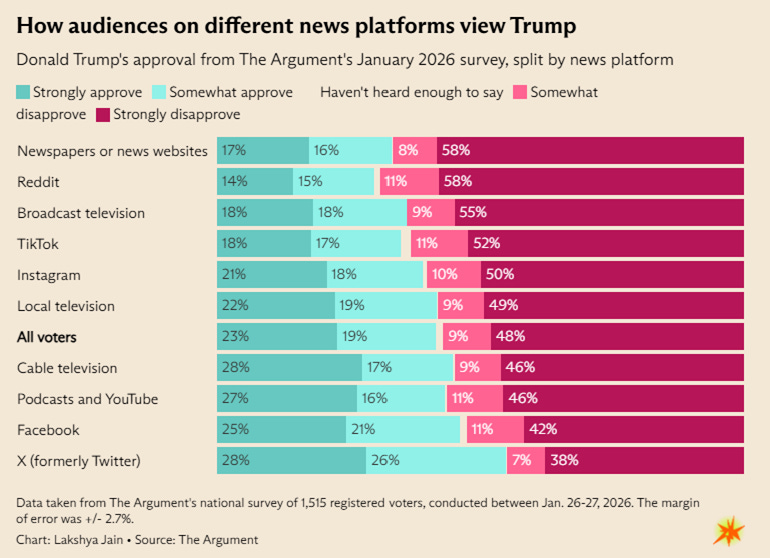
“Twitter is not real life” by Lakshya Jain. People who read newspapers and news sites lean left. People on Twitter lean significantly Right.

“Don’t Let Elon Musk Implant a Device in Your Skull” by Emily Topping.
https://www.currentaffairs.org/news/please-dont-let-elon-musk-implant-a-device-in-your-skull
What Is To Be Done?
“A.I. May Put Progressives to the Test” by Ross Douthat. Left-wing discourse on A.I. feels like a collection of irritable mental gestures in search of a consistent theme.
https://www.nytimes.com/2026/02/10/opinion/ai-politics-left-progressive.html?smid=nytcore-ios-share
“Selling AI to the left” by The Economist. Britain’s government makes the union-friendly case for artificial intelligence.
https://www.economist.com/britain/2026/02/05/selling-ai-to-the-left
“Take Back Tomorrow with Gerd Leonhard” on London Futurists. Gerd is a leading professional futurist, and he has been moved to create a political agenda to protect European democracy.
“Progress for progressives: The “party of science” must also embrace technology and economic growth” by Jason Crawford. The Left needs to rediscover abundance and growth.
