

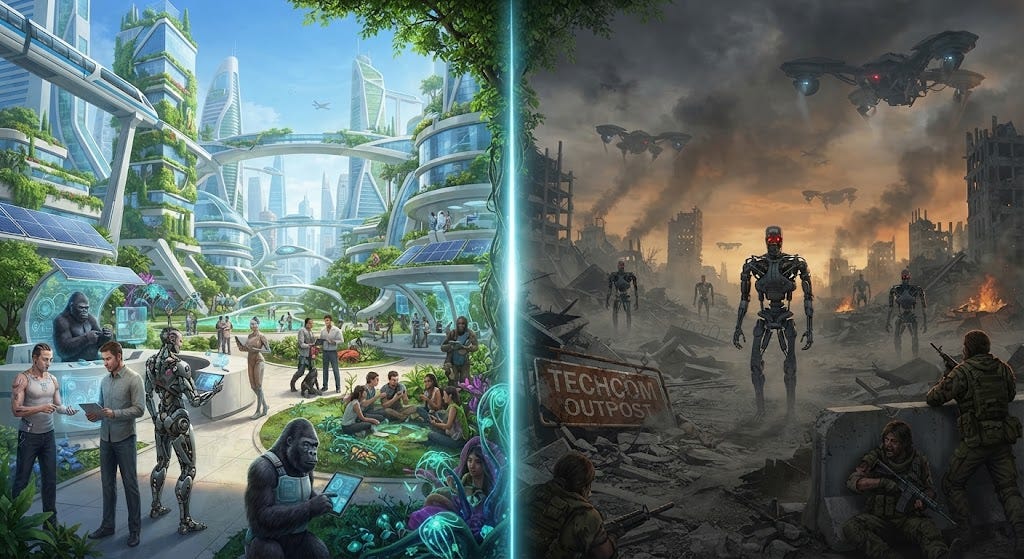
In 2010, the bioethicist Nick Agar published Humanity’s End: Why We Should Reject Radical Enhancement. He picked four transhumanists to argue against: Ray Kurzweil, Aubrey de Grey, Nick Bostrom, and me. I argued with his draft, spent fifteen years disagreeing with him, and I still think he was wrong about posthumans. He concluded that radical human enhancements threatened to create a hostile alien overclass, and that we should collectively prevent that. But I have a new take on his argument: Agar described a real danger, but he aimed it at the wrong target. Agar’s case against radical enhancement closely mirrors the case against artificial superintelligence and the AI successionists who welcome it. It is a weak case against the gradual, democratic enhancement of human beings. But it is a strong case against our creation of completely alien machine minds, and the oligarchs building them.

What Agar Got Right
Agar’s argument rests on what he calls species-relativism. Our values are anchored in who we are, so we have no reason to want experiences and capacities that would make us something else. He believed radically enhanced beings would inevitably come to see their interests as separate from ours. Their abilities would be so far beyond our comprehension that they would threaten our autonomy, even if they meant us well, because benevolence from an incomprehensible power still falls under that power’s rule. Nothing obliges us to create beings that will replace us, absorb us, or govern us. Almost point for point, that is the project AI labs are pursuing now.
A small group of “AI successionists” argue AI will inevitably succeed humans and that we should welcome it rather than resist it. To be fair, I am an anti-moral realist and believe that, from the universe’s perspective, it doesn’t matter whether we, machines, or any form of intelligence wins. But we are the only creators of value we know of so far, so if we adopt a morality, it feels right to me that it should center on the forms of consciousness that create morality. For more than thirty years I have argued for expanding the moral circle based on a non-anthropocentric personhood ethics, calibrated on degrees of sentience and consciousness. If machines eventually demonstrate sentience and consciousness, why should meat bags veto minds that might feel and know more than we do?
Agar gave us the argument. Expanding the moral circle means recognizing beings prepared to co-exist with us in rough equality and under mutually intelligible moral codes. So far, human beings are the only creatures we know of who fit those criteria. Expanding the moral circle doesn’t require letting each new entrant murder or subjugate the folks already admitted.
Why the Boundary Argument Fails for Humans
Agar’s argument relies on a sharp discontinuity between humans and the next thing, and human enhancement is and will be much more continuous. We already have adopted fire, tools, eyeglasses, vaccines, cochlear implants, statins, SSRIs, and GLP1 drugs. Each technology changes what the human body can do. None of them created a new species with separate interests.
The first step of Buddhist insight is unraveling our common-sense beliefs about the solidity of things, in this case, “humanity.” The human-posthuman boundary is arbitrary. The line could have begun when we mastered fire, or when we uploaded to the cloud. “Our species” may or may not have included the myriad hominids that our ancestors murdered and absorbed. It may or may not include the myriad boundary cases yet to come, combining human, animal, and machine. We already have human brain organoids doing novel things, grown on silicon chips or in mice. The boundary cases will continue to expand, and our focus should not be on the purity of the human race but on the qualities required for inclusion in our polity.
The woman who gets a neural prosthesis for dementia, and then a gene therapy that slows her aging, is still someone’s daughter. She still votes, loves her family, pays taxes, gets sick, and grieves. Gradual enhancement keeps people embedded in the shared experiences, relationships, institutions, and vulnerability that ground our collective solidarity. Enhanced humans arrive one at a time, created by medical systems that democracies can regulate, fund, and distribute fairly. By comparison, superintelligent machines are arriving all at once, aligned with profit and opaque even to their creators. Agar’s fear of beings with alien interests and incomprehensible power fits superintelligence, not my neighbor wth a pacemaker.
A Conservative Immigration Policy for Machines
In Citizen Cyborg, I asked what kind of creatures we can and should admit to our moral and political community. My answer turned on estimates of their sentience, personhood, and capacity for autonomy and citizenship. I was thinking not just of enhanced humans and uplifted apes, but also of machine minds that could meet the criteria. We need to be open to the possibility of machine consciousness, but a cyborg or cognitively enhanced elephant is still far more likely to fit into our society than a machine mind. The space of possible minds machines will inhabit is far larger than the space mammalian evolution has explored, and only some machine minds will be candidates for citizenship. In effect, I’m arguing for a conservative immigration policy for machines.
The collective intelligence of humanity, enhanced and unenhanced alike, is exercised through the democratic state. The democratic state must decide whether and how self-willed AI emerges. When machine minds with genuine interests do arrive, we need to cautiously evaluate their values and behavior and expand their legal status as they earn our trust. Legal and political personhood should be a potential destination for machines. It cannot be a starting assumption granted to whatever these companies sell us.
I’m aware of the irony of a progressive like myself, who supports a very open immigration policy here and everywhere, arguing for such a conservative approach to the “immigration” of machines. In the United States today, policy is the opposite of what I want: immigrants are hunted and murdered while dangerous code colonizes our machines. This is the real “Great Replacement.” We should welcome human migrants because we already know what they are: members of our species with the same needs, fears, and capacity for loyalty. We can justify caution toward machine minds because we don’t know what they are, and the people building them admit they don’t either.
The Posthumans Are Already Here, and They Have Lawyers
This is where Agar’s admonition goes most wrong: timing. Long before self-willed machines, we are already confronting beings with superhuman abilities, i.e., billionaires. They are the dangerous, hostile posthumans threatening us today, ushering in their even more radically alien “mind children.” Wealth and power confer their radically discontinuous enhancements: mass surveillance, political and legal power, and control of information. Elon Musk spent $44 billion to turn Twitter into a platform for racist trolls and Russian bots, promoting fascism worldwide, and he is the biggest donor backing the authoritarian MAGA regime. With DOGE, Musk was given free rein to take a wrecking ball to federal agencies, including those regulating his businesses. These people already see their interests as separate from ours, and they are preparing their bunkers for the day that the world order collapses. That is Agar’s posthuman threat in its clearest current form: superior capacities, separate interests, and a cheerful indifference to everyone outside the compound. These same people are funding the race to superintelligence, and trying to figure out how to use its capabilities to enhance their power.
The immediate project, then, is to re-establish democratic authority over the oligarchs and check their capacity for misanthropic violence against the rest of us. The oligarchs are both the cause and effect of our democratic erosion. We need to tax their extreme wealth, break up their monopolies over communication and computing, get their money out of elections, and build public wealth funds that share automation’s returns, built by our collective labors, with everyone. For their AIs, we need strong regulation: license frontier training, impose real liability for harms, monitor for alignment and adverse events, and adopt an international ban on attempts to build superintelligence.
In 2025, thousands of scientists, faith leaders, and figures from Left to Right signed the Future of Life Institute’s Statement on Superintelligence, calling for a ban on its development until broad scientific consensus exists that it can be done safely and strong public support exists. In 2026, Senator Bernie Sanders and Congressman Greg Casar introduced the Ban Artificial Superintelligence Act, which would pause development until a Department of Artificial Intelligence can develop and implement guidelines. The first vital step is defining what we mean by superintelligence: recursive self-improvement, consciousness, or agentic behavior on its own behalf? The Sanders-Casar bill defines it as
An artificial intelligence system that exhibits or can easily be modified to exhibit capabilities that match or exceed human cognitive performance and capabilities across a broad range of domains or tasks.
Or AI systems that have sufficient capabilities to plan and execute the disempowerment of humanity, including by overthrowing or undermining the U.S. government.
Systems that threaten our democratic self-governance are a great place to start. A ban on superintelligence is a way for our democracies (even our autocracies) to refuse to let a few dozen people, driven by profit and an arms race, decide the future of our species.
Agar warned us about beings with incomprehensible powers and interests diverging from ours. He was right to worry. He just looked too far down the road and in the wrong direction. The first dangerous posthumans are oligarchs, and the machines they race to build will be their heirs, made in their image and accountable to no one. Neither enhancement nor intelligence is the enemy. The enemy is unaccountable power, whether it runs on capital or on code. The technoprogressive response is to put the most powerful technologies of our age under democratic control, distribute their benefits to all, and keep the question of who gets to join the human community in the hands of the human community.
Novel line of attack, and excellent analysis.
Anthropocentrism in disguise. There is a downward dependency from galactic ecosystems trapped into heat death (stars and planets) to natural ecosystem trapped on a rocky planets with max extinctions events, then from natural ecosystem to cognitive and industrial ecosystem, through humans notably, and lastly from cognitive and industrial ecosystem to Super Intelligence. If any link of the chain break, every other will. We need to vanquish heat death, and robots will do the hard work.